
Pivotal People
The story was made possible because of the tenacity of a few committed, determined and generous people. Read about those who made it happen.
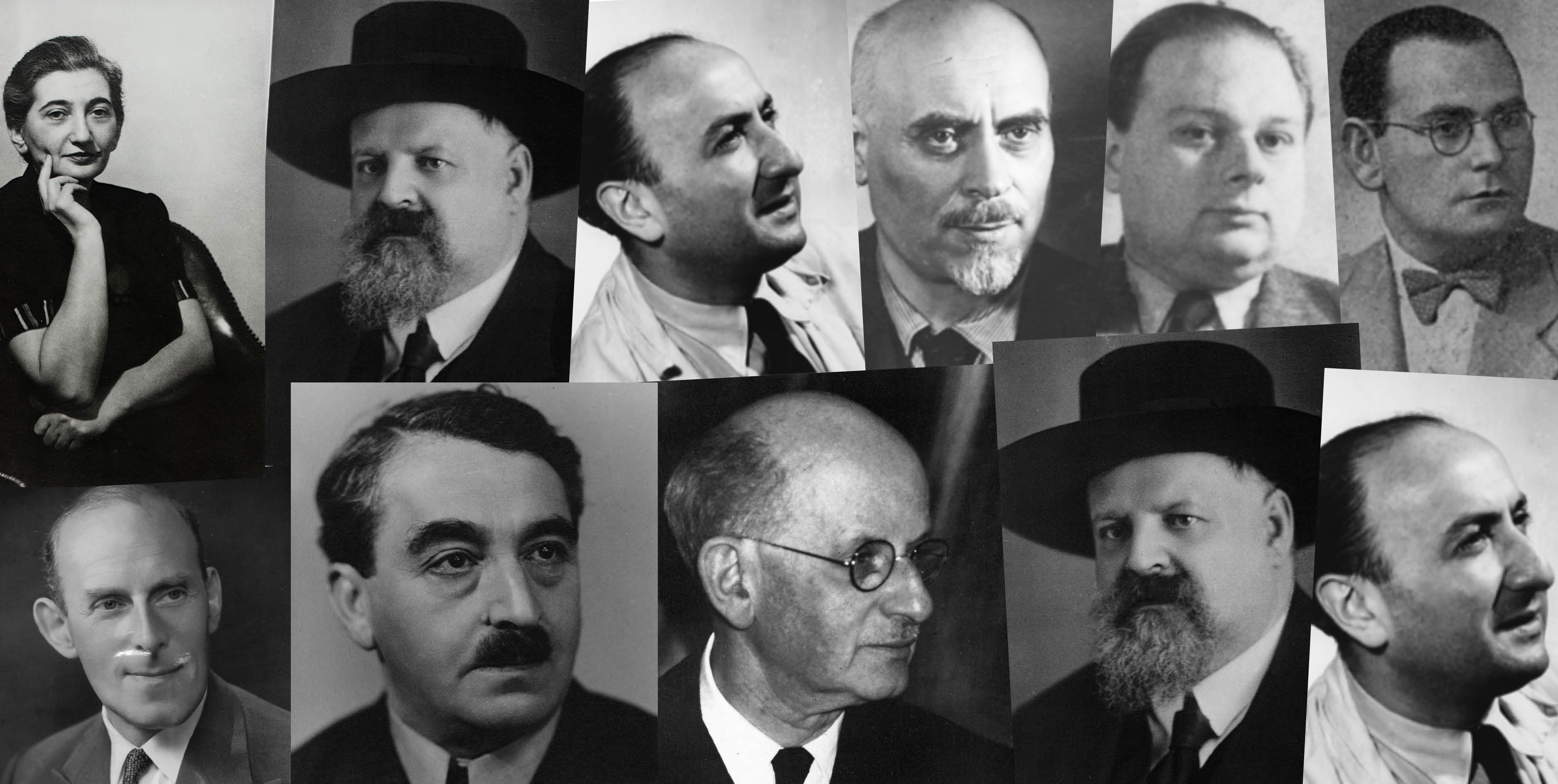
Prague People
Alfred Engel
1881-1944
A high school teacher of classical languages, he was very interested in the history of Jews in Moravia. During WWI, he took care of Jewish emigrants from Galicia and even became a special envoy of the Ministry of the Interior in this area. When the Central Jewish Museum for Moravia and Silesia in Mikulov (Nikolsburg) was established in 1936, he became its curator and actively searched for objects that would enrich its collection, thus creating a representative picture of Moravian Jewry. After the Mikulov Museum’s holdings were moved to Brno in May 1938, Engel, who had no family, left for Prague. In the spring of 1942, the Mikulov museum collection was transferred to the capital, which was an important step on the way to founding the Central Jewish Museum in Prague a couple of months later. Engel then joined the team of the Central Jewish Museum where he worked till his deportation in July 1943. He did not survive the war.
Dr. Tobias Jakobovits
1887-1944
The former Librarian of the Prague Jewish Community, he became the Scientific Head of the Central Jewish Museum in Prague. Together with S. H. Lieben, he co-curated the wartime exhibition of Hebrew manuscripts, prints and books. He coordinated the work of his colleagues and had the main responsibility for the museum. It was he who usually had to guide the rare visitors from the Zentralstelle für jüdische Auswanderung through the museum’s installations. In the autumn 1944, together with his family and a few colleagues from the Prague Jewish community, he was deported directly to Auschwitz and immediately murdered.

Salomon Hugo Lieben
1881-1942
A high school teacher by profession, he was the founder and spiritus agens of the Jewish Museum in Prague in 1906. He was very active socially, a member of numerous societies, some of them very prestigious: e. g., he was the Head of the Prague Chevra Kadisha, the Burial Society and a long-time Board member of the Prague Jewish community. He was also the author of several important historical essays on Bohemian Jewry based often on historiographical material [chronicles etc.]. During WWII, he worked for the Prague Jewish Community and also became involved with the Central Jewish Museum where he was a co-curator of the first installation focused on Hebrew manuscripts, prints and books. He died of a stroke in Prague in the autumn 1942.

Josef Polak
1886-1945
A lawyer by profession but a professional museologist and art historian by choice, he was Director of the state East-Slovakian Museum in Košice until his return to Prague in the autumn of 1938 due to the current political situation in Slovakia. In 1942, he was appointed to take charge of cataloguing the incoming mass of artefacts by the Prague Jewish community and to give his expertise on the museum. He created the scientific programme of the museum, set up the card index system and established the meticulous rules and procedures that ensured consistent methodology even as members of the museum staff were being deported and replaced. He curated most of the war-time museum installations. Temporarily “protected” by a mixed marriage, he was eventually arrested for his support of the resistance movement and disappeared in Auschwitz in January 1945.

Karel Stein
1906-1961
Stein studied law but in the first months after the Munich Agreement in September 1938 and after the occupation of Bohemia and Moravia by the Nazis in March 1939 he was – like so many others – forbidden to follow his profession as a lawyer. He then started to work for the Prague Jewish Community becoming the Chairman of the Department of Provincial Affairs.
Aware of the situation of the Jewish communities in the so-called Protectorate Bohemia and Moravia, it was his idea to gather all liturgical objects, books and archive records from Bohemian and Moravian synagogues in Prague to keep them safe for after the war.
He was one of the few to survive and in 1945, he became the Head of the Prague Jewish Community. Following the Communist Putsch in 1948, he left the country for Israel in 1949. He died before being able to testify at the Eichmann trial.

Frantisek Weidmann
1910-1944
Weidmann was a lawyer but shortly before the war, he worked as a secretary to the then Chairman of the Prague Jewish Community, Emil Kafka. After Kafka left the country, the new Nazi body in charge of the Protectorate Jews, the Zentralstelle für jüdische Auswanderung [Central Office for the Emigration of Jews], ordained Weidmann to be the Head of the community. Weidmann actively supported the idea of creating a Central Jewish Museum and it was he who hired a known specialist in the field of museology, Josef Polák, to help with building it up in a professional way. In January 1943, he was deported to Terezín and did not survive the war.

Hana Volavkova
1904-1985
Being an art historian and librarian, she joined the museum’s team in the spring 1943 to assist Josef Polák. Together with him, she worked on an exhibition on the history of the Jews of Bohemia and Moravia and another on the Jews of Prague. After Polák was arrested and most of the staff were deported in the autumn 1944, she took over the coordination of the museum’s work. Being temporarily “protected” by her mixed marriage, she was deported to Terezín in February 1945. The only specialist at the Central Jewish Museum to survive the war, she saved the Museum in the post-war chaos, becoming its Director under the Communist regime in 1950. Feeling responsible for remembering the fate of Bohemian and Moravian Jews, her own family members and her colleagues from the war-time museum, she fought to keep the collections intact after the war.

Fraintisek Zelenka
1904-1944
An architect and noted theatrical and costume designer before WWII, he found refuge with the Prague Jewish community at the beginning of the war where he took care of its many buildings and historical sights. Later he was recruited to help implement the plan of creating a museum once the stream of artefacts began to arrive in Prague. He was responsible for the artistic design of the war-time installations even though they were not intended for the general public. After his deportation to Terezín, he continued his work. He organized and staged more than 25 theatre plays there, including the children opera Brundibár which he also directed. He died during his deportation from Terezín to Auschwitz.

London People
Chimen Abramsky
1916 - 1910
Professor Chimen Abramsky was professor of Jewish Studies at University College London. He was born in Minsk the son of Rabbi. He gained a BA degree from the Hebrew University of Jerusalem and an MA from the University of Oxford. He was Reader in Jewish History, then Goldsmith Professor of Hebrew and Jewish Studies at University College London. He was a Senior Fellow at St Antony’s College, Oxford. A noted scholar of Jewish History, Abramsky was also well known as an expert and antiquarian Hebrew books and manuscripts, and was an advisor on Hebraica and Jusaica for many years to the auction house Sotheby’s, Ralph Yablon arranged for him to travel to Prague and to report on the condition of the scrolls.

Eric Estorick
1913-1993
Eric Estorick born in the USA and moved to England after marrying Salome Dessau. He was the owner of the Grosvenor Gallery in London and frequently visited eastern Europe in search of works of art from Russia and the communist countries. He was approached in Prague by Artia, the Czech government company which managed the sale of cultural items, to ask if he was interested in the purchase of a large quantity of Jewish artefacts. He contacted Ralph Yablon, who was a customer of the Grosvenor Gallery and subsequently, acting on the latter’s behalf, was able to negotiate the sale of the scrolls by Artia to Ralph Yablon.

Harold Reinhart
1891-1969
Rabbi Dr. Harold Reinhart was born in Portland, Oregon, and trained as a rabbi at the Hebrew Union College, Cincinnati. He was the leader of several congregations in America before being invited to become Senior Minister at the leading Reform Synagogue in London, the West London Synagogue of British Jews. He was responsible for enabling some of Germany’s Progressive rabbis to escape to England, where they obtained posts, leading to the expansion of Reform Judaism in this country. In 1957 he and some of the leading members of his community left West London to form The Westminster Synagogue, which eventually settled at Kent House in Knightsbridge.

Ruth Shaffer
1910 -2006
Ruth Shaffer was born in Warsaw, the daughter of the Yiddish writer, Sholem Asch. She lived in Europe and America, before settling in London, where she and her husband joined Westminster Synagogue. Her friendship with Rabbi Reinhart led him to invite her to help with the increasing workload of the Scrolls organisation, a task which she fulfilled faithfully for nearly forty years, working almost single handedly for much of the time. She set up the scrolls database, first on index cards and later on computer, which she learned to use in her eighties. Her system was the basis for all the subsequent work connected with the scrolls. She was the driving force behind the project and she and the Trust became synonymous. Her ability to speak Yiddish was crucial in her close working relationship with David Brand, the Sofer.

Frank Waley
1893 - 1987
Having served with distinction in World War I, where he earned the MC, Captain Frank Waley was a founder member, first Chairman and the second President of Westminster Synagogue. He was also the Chairman of the Memorial Scrolls Committee (as it was initially known).
His brusque manner hid a warm heart and a great sense of humour, and he was an enthusiastic and indefatigable supporter of the Scrolls project from its inception. He was a distinguished gardener and was awarded an OBE for his services to arboriculture.

Ralph Yablon
1906-1984
Ralph Yablon, after many years as a practising solicitor, developed a wide range of commercial and academic interests, and was also a prominent philanthropist. He was a founder member of Westminster Synagogue, and he and his wife Phyllis were close personal friends of Flora and Rabbi Harold Reinhart. He had been instrumental in finding a permanent home for the congregation at Kent House, and with others helped to finance its purchase. His first reaction to the information he received about the scrolls was to seek guidance from Rabbi Reinhart, and together they determined to pursue the matter and to take on the awesome responsibility for the scrolls. Ralph Yablon duly purchased the scrolls and donated them to Westminster Synagogue. In due course the Czech Memorial Scrolls Trust was created to take over the formal responsibility for the scrolls. Ralph Yablon was a Trustee and provided further financial support for rent and materials, until his death in 1984.
